No products available yet
Stay tuned! More products will be shown here as they are added.

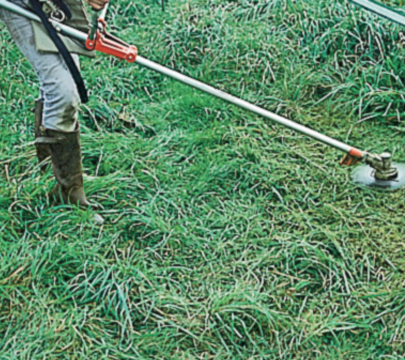
Electric fences, as mentioned, have their weaknesses: they work so well that we don't maintain them! Controlling weeds or grass touching the tape greatly decreases the optimal performance of the system, and without power, your tape becomes a tight rope that your horse will use to scratch itself. It doesn't take much. There are in fact many ways to combat weeds: regularly mowing the grass growing under the tape and all the plants the horse doesn't eat, working the soil under the tape; applying a mild herbicide in a band about 60 cm wide under the tape, being careful not to touch the tape. Always use the same height from the ground, horses will never try to go over or under it. Always use a very powerful energizer.
After years and years of honorable work, the white tape (only the white, not the brown or green) turns gray from dust and smog, or greenish from mold if under trees. Not to do indirect advertising, but Liquid Ajax or Mr. Clean or a good kitchen degreaser (as long as it is not based on common thinners) serves the purpose: soak a cloth and gently wipe the tape. It will look like new again! You will hardly avoid spider webs or the laying of eggs and larvae, but they do not cause damage other than small electrical dispersions.
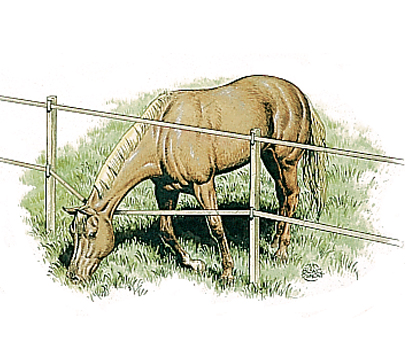
The wind is a tireless enemy of the electric tape. Never exceed 5 meters of distance between one post and another and even go down to 3 meters if you live in windy areas like Trieste. Conversely, there is no need to use thick posts in the space between one corner and another or between the ends. The only thing we ask of intermediate posts is to keep the tape in position and at the same height. The posts at the ends, which will have the task of keeping the tape taut, will be larger and stronger. By building a temporary fence with few posts, you will cause the tape to vibrate strongly in the wind. Some are happy with this, but the result is that the tape vibrating inside the insulator will wear out. Plastic against plastic will wear. This is another reason why we added the two shockproof polyester threads. Everything is then optimized by the Ref. 8N insulator, special for the tape, and by the special weave of the tape itself which lets the wind pass through with minimal vibrations. This solution solves the vibration problem without compromising the technical characteristics of the tape.
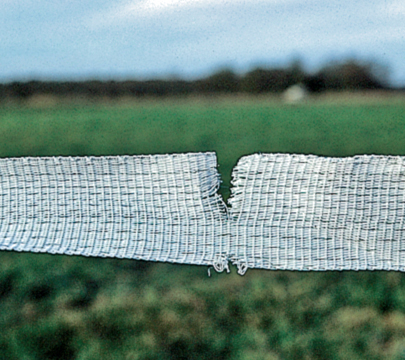
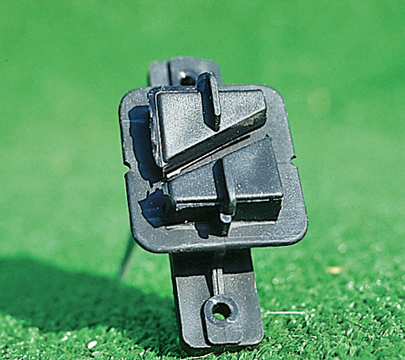
As the etymology of the word states, the insulator must isolate. Be sure of it, because it is extremely important that it does not discharge onto iron posts, wooden ones, and all surfaces—even more so if wet—on which you want to fix it. But be careful with the competition: do not buy insulators that were not built specifically for the tape. Very often you come across insulators built for wire or rope, or even worse, that are supposed to serve multiple purposes: a few months and the tape will be broken or frayed.
Beware also of those insulators not treated against UV rays: the sun's rays consume them and so they become brittle, enough to crack them and make them no longer "insulating" with moisture, making the system ineffective.
The lack of experience of some manufacturers leads to negative results, which then in case of wind and in any eventuality make the careless buyer bitterly repent.
Once this fencing system was conceived and implemented, it was previewed at the Paris Horse Show. For the first time in the history of this show, our system won three Oscars: one for best innovation, one for best technical research, and one for best equipment. From that moment we took it all over the world to make it known. From Canada where it has to work even at -40°C, where it had to have a plastic that resisted without breaking, to Saudi Arabia, where with its scorching heat we found treatments that made it very strong and resistant; the experience gained in areas like Australia, New Zealand, South Africa, Mexico, the USA, where in certain areas the burning sun is unforgiving to plastics like polypropylene, forced us to use anti-UV treatments that guarantee us optimally. The addition of the two shockproof polyester threads, also well protected from UV rays, has made the Tape even longer-lasting. From test to test, we arrived at a type of plastic that improves its characteristics with exposure to the sun's ultraviolet rays (which, to be honest, surprised us).
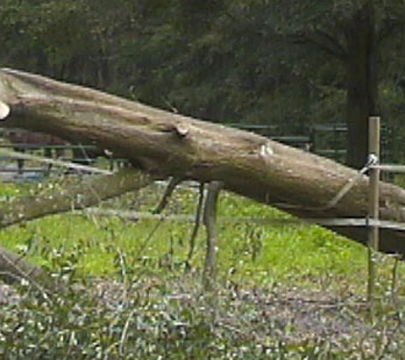
Although our energizers are protected by 9 varistors and a fuse, during storms it is always best to disconnect your device from both the power supply and the tape. As soon as the danger has passed, reconnect the power. Lightning protection systems found on the market actually can do little or nothing against a lightning strike that must be measured in millions of Volts. Fortunately, the incidence of lightning damage is not great. The latest generation of our energizers also has the possibility of interchangeable parts which, for a modest sum, allows repair in many cases. To help you against this uncontrollable and terrifyingly strong phenomenon, we have studied the following system.
Connect the special lightning arrestor Ref. 53A to the tensioner Ref. 44 (which connects to the energizer) and the latter to the ground post Ref. T1. This way the lightning will find a way to the ground and will not hit your energizer.
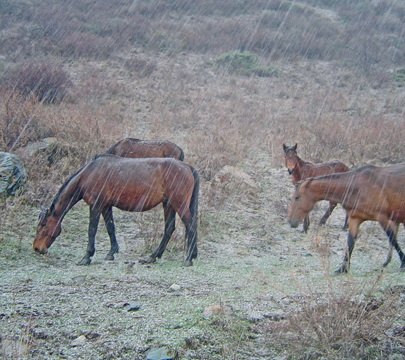
On rainy days, although the fence theoretically should work better (better phase/earth connection), very often due to dirt, grass, or plants touching it and grounding it now that they are wet, the functioning is slightly reduced. The dispersion that increases with the rains should not scare you because with our energizers the problem will go unnoticed. With snow, we will see the tape become heavier and seem to loosen slightly: the effect is caused by the flakes sticking to the cold surface of the tape and thus weighing it down. Don't worry, just shake it to make it return to normal. In the event of heavy snowfall where the low tape is completely covered by the blanket of snow, there are no problems: just do not connect it and leave only the upper one connected.
Just remove two insulators from the closest sides between the fences, replace them with two contact tensioners Ref. 44, cut and connect or just pass the tape inside the tensioner; insert the Teflon cable Ref. 28 in a sheath that allows maintenance once buried; you do not need an incredibly large trench, 20 cm is enough, under driveways it must be deeper. The connection must be ensured by the Teflon cable with two Ref. 59G connectors which, tightened on the cable, connect it with the contact tensioner Ref. 44.
It must take place between Switches Ref. 52, with the same cable Ref. 28, so that they are independent.
Warning!!! Always calculate that the earth must not be too far away! If you have a door not made of tape, you will have to guarantee the passage of current as described above for the in-line connection.
You may be interested in:
Stay tuned! More products will be shown here as they are added.
check_circle
check_circle